World Forging Championship
The world forging championship is the most popular event at the biennial fair, attracting thousands of visitors and over 200 blacksmiths each year.
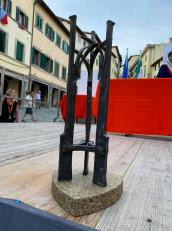
The current format of the event represents the evolution of the extemporaneous forging competition, held for the first time in 1981 on the occasion of the 4th wrought iron craft fair. Back then, it consisted of creating a work on a free theme in the presence of the public. The present championship, instead, takes place according to precise rules set by the Biennale association, which establish, among other things, a specific theme for each year.
For this edition, the theme is “MYTHS AND MAGIC.”
The theme to be followed is announced to potential participants well in advance, usually in June, through social media and the Biennale’s website, so that blacksmiths can carry out all the necessary preliminary operations: conception, sketch design, study of materials, and adaptation of the project to the time available. According to the regulations, each participant has a maximum of three hours for the forging test, and the work must be created entirely on the spot, without the use of any pre-fabricated parts. The object must, of course, be made of iron, forged using traditional techniques, that is, without the aid of machinery. However, small parts in other materials may be included (glass, crystal, or metals other than iron have generally been used).
The competition takes place in Piazza Mazzini in Stia, where 12 workstations are set up, each equipped with its own forge, work tools, and various bars of different types of iron. Artisans may use the tools provided but also their own, since the creation of personal tools is one of the distinctive features of the blacksmith’s craft.
Each workstation is overseen by a supervisor who, during the process, ensures compliance with the regulations. The competition is structured in two categories: individual and team. In the team test, a group may consist of up to four blacksmiths who work simultaneously on the same piece; the individual test, instead, involves a single blacksmith, who may nevertheless be assisted by a “helper.” The helper’s sole task is to support the smith in the basic hammering operation, following the rhythm, without intervening in any of the other operations or decisions that determine the outcome of the work.
In the individual competition, the winners were:
001
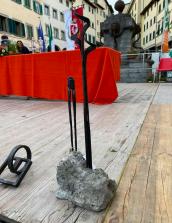
Yoav Berger (Israele) - Circle of life
002
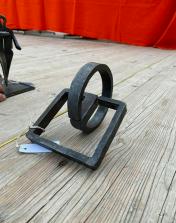
Roman Kost (Ucraina) - Connection of differences
003
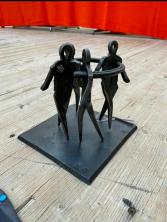
Martin Holl (Germania) - Together
Nella gara a squadre i vincitori sono stati:
001
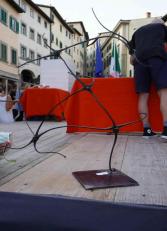
Gruppo Germania 3 (Cartsens, Dirr, Upmann, Ludwing) - Puzzle
002
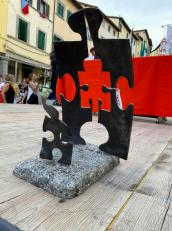
Gruppo Repubblica Ceca (Lubos, Tulis, Kucera, Soulup) - Memory of Santini 1723-2023
003