Biennale Arte Fabbrile – 50esimo Anniversario

July 16, 2026
WORK HAS BEGUN ON MICHELANGELO PISTOLETTO'S "THIRD PARADISE" IN WROUGHT IRON FOR THE 50TH ANNIVERSARY OF THE EUROPEAN BIENNIAL OF BLACKSMITH ART IN STIA
The first previews of the celebratory calendar, scheduled for September 4–6, 2026, have also been announced.
Michelangelo Pistoletto’s Third Paradise in wrought iron is beginning to take shape, created to mark the fiftieth anniversary of the European Biennial of Blacksmith Art in Stia. This event has been showcasing artistic and artisanal ironwork since 1976, and is promoted and organized by the Autonomous Association for the Biennial of Blacksmith Art in Stia and the Municipality of Pratovecchio Stia, in the province of Arezzo.
From September 4–6, 2026, a special year will be celebrated, spanning the 26th Biennial and the next regular edition, with a comprehensive program of events centered on the sculpture’s unveiling.
In the S.T.I.A. workshop, – School Training Iron & Arts: The forges are lit to create one of the most emblematic works by Pistoletto, a leading figure in Italian contemporary art. This project is curated by Loris Innocenti and Tommaso Venco of Hexisart, in collaboration with the Pistoletto Cittadellarte Foundation, with Francesco Saverio Teruzzi as its coordinator.
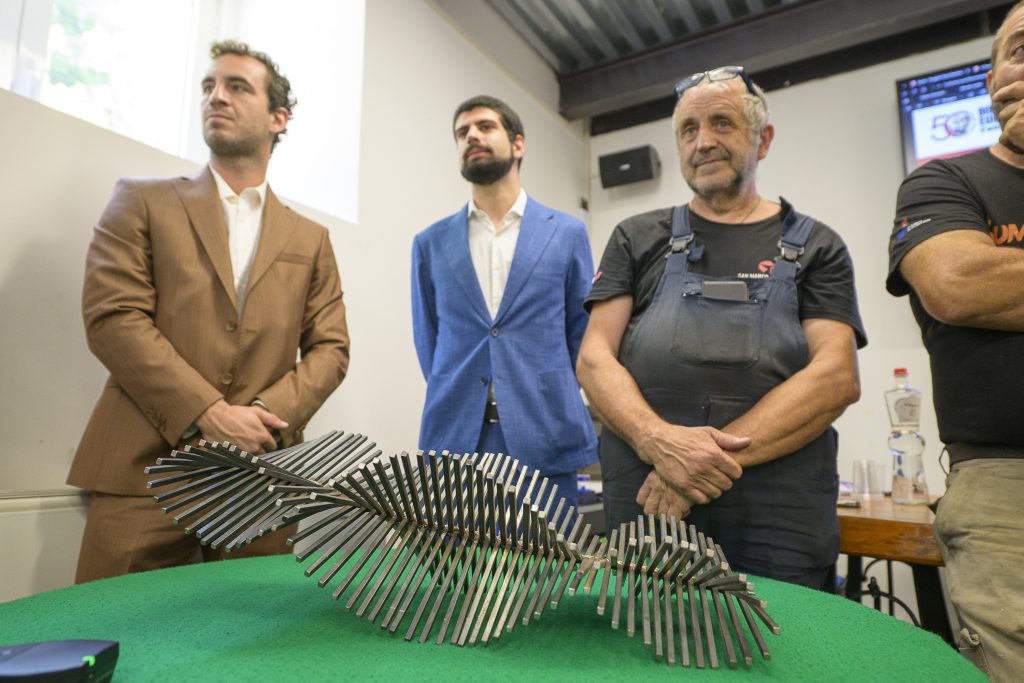
The project will be created by a team led by art blacksmiths Roberto Magni and Martino Stenico, who designed the sketch, along with the artistic director of the Biennale, interpreting the famous symbol that represents the possible balance between nature and artifice, between technological innovation and environmental responsibility.
The design concept draws inspiration from a game in which balance is the fundamental element: the Shanghai stick game. The intertwining of individual sticks creates a dynamic composition that recalls two opposing elements, evoking the principle of balance between opposites.
The structure will be composed of 100 iron elements: 50 will form the central core, in homage to the 50th anniversary of the Stia Biennale d’Arte Fabbrile, while the remaining 50 will be distributed 25 per side.
The ends of each element will be made of polished stainless steel, a design choice that gives the work luminosity and enhances its visual impact. The reflection of light thus becomes an integral part of the expressive language of the project, metaphorically symbolizing the ongoing search for knowledge, hope, and the dialogue between tradition and the future.
A symbol of the dialogue between contemporary art and the blacksmith tradition, the sculpture will become part of the collection of the Municipality of Pratovecchio Stia and will be placed in the Parco delle Terme del Palagio Fiorentino and officially handed over to the community during the fiftieth anniversary celebrations.
The Third Paradise will also be one of the wrought-iron installations on the new permanent art trail that will run through the historic center of Stia, created by blacksmiths participating in various editions of the Biennale d’Arte Fabbrile (Blacksmith Art Biennial). This urban museum will have its ribbon-cutting ceremony during the celebrations.
The fiftieth anniversary celebrations of the Biennale d’Arte Fabbrile will also be an opportunity to retrace the event’s history through its key figures. During the event, awards will be presented to some of the most representative master blacksmiths who have participated in past editions and to those who, with their contributions, have made the Biennale an international reference point for the world of forging and wrought iron.
The celebratory calendar will also include the construction of the new entrance gate to the S.T.I.A. green area. Academy, a work born from the winning project of the 10th “Pier Luigi della Bordella” International Design and Drawing Competition, held as part of the 2025 Venice Biennale. This work demonstrates the dialogue between young designers and master blacksmiths, a hallmark of the event.
The Third Paradise is a symbol that Michelangelo Pistoletto imagined in 2003, but it is the fruit of his entire research: the search for self through images and relationships with others. Here in Stia, this symbol does not enter the community, but rather the community translates the symbol into its own reality, its own tradition. I would like this message to remain: we will not have a Third Paradise made of iron, but a Third Paradise made of relationships. Pistoletto, at over ninety years old, continues to send messages that speak of a new balance between what nature has given us and what man creates. The community of Stia and the Biennale have successfully embraced this message, translating it into their own reality, into the tradition of blacksmiths, who dialogue with the material, transform it, but never impose themselves on it. Saverio Teruzzi, official representative of Cittadellarte – Fondazione Pistoletto.
“Celebrating the fiftieth anniversary of the European Biennial of Blacksmith Art represents an important milestone not only for Pratovecchio Stia, but for the entire Casentino area. In this half-century, the Biennial has
It has strengthened the bond between Stia and the art of wrought iron, keeping alive a tradition deeply rooted in our history and making it known and appreciated in Italy and abroad. Making this anniversary even more significant will be the creation of Michelangelo Pistoletto’s “Third Paradise,” a work by one of the greatest protagonists of contemporary art, which will take shape thanks to the work and expertise of our master blacksmiths. Luca Santini, Mayor of Pratovecchio Stia
“Since the Biennale’s founding, it has been a journey of continuous growth that has seen the event become the most important exhibition in Europe, attracting the most prestigious blacksmiths in the world. After 50 years, the work continues to grow with the same spirit and vigor, and with the prospect of further developments. The creation of the Third Paradise by the Biennale’s blacksmiths, designed by the master Pistoletto, will confirm the success of an event that has always promoted the union of tradition and innovation, craftsmanship and art, natural materials and artifice,” said Piero Milli, president of the Autonomous Association for the Biennale of Blacksmith Art.
“Combining Pistoletto’s trinamic style with the strength of local wrought iron means celebrating the mastery of the region and restoring its cultural centrality. For Hexisart, working in Stia means demonstrating that when contemporary art marries the productive identity of a region, it generates social, economic, and cultural value that remains as a permanent heritage for the entire community.” Loris Innocenti of Hexisart.
“On the occasion of the fiftieth anniversary of the European Biennale of Blacksmith Art, we wanted to create a work that went beyond the simple celebration of technique, giving shape to an installation capable of establishing a dialogue between artisanal tradition and contemporary thought. With this installation, we didn’t simply want to create a sculpture, but to leave a permanent mark on the community, capable of celebrating an important anniversary while also looking to the future.” Tommaso Venco of Hexisart.
EUROPEAN BIENNIAL OF BLACKSMITH ART IN STIA: Founded in 1976 from an idea by Pier Luigi della Bordella, Ivan Bruschi, and the then mayor Vittoriano Frulloni, the European Biennial of Blacksmith Art in Stia is today an international reference point for the world of forging and wrought iron. Every two years, it transforms the Casentino village into a vast open-air workshop, attracting blacksmiths, artists, artisans, schools, scholars, and enthusiasts from around the world. The event, considered the longest-running exhibition of artistic wrought iron craftsmanship in the world, combines competitions, live demonstrations, exhibitions, contests, meetings, workshops, and opportunities for dissemination, with the aim of promoting a tradition deeply rooted in the area and projecting it into the future.