Biennale Arte Fabbrile – 50esimo Anniversario
July 3, 2026
MICHELANGELO PISTOLETTO'S THIRD PARADISE FOR THE 50TH ANNIVERSARY OF THE STIA BIENNIAL OF BLACKSMITH ART
Thanks to the collaboration with the Fondazione Pistoletto Cittadellarte, on the occasion of the anniversary, the wrought iron artwork will be created
On the occasion of the fiftieth anniversary of the Biennale Europea d’Arte Fabbrile di Stia (European Biennial of Blacksmith Art of Stia), in the province of Arezzo, the Terzo Paradiso (Third Paradise) by Michelangelo Pistoletto will be created in wrought iron. The project, curated by Loris Innocenti and Tommaso Venco of Hexisart, stems from the collaboration with the Fondazione Pistoletto Cittadellarte and Francesco Saverio Teruzzi as its representative, and stands as one of the central events in the celebrations of this initiative dedicated to artistic and artisanal ironworking, promoted and organized by the Associazione Autonoma per la Biennale d’Arte Fabbrile di Stia and the Municipality of Pratovecchio Stia.
Born in 1976 from an idea by Pier Luigi della Bordella, Ivan Bruschi, and the then mayor Vittoriano Frulloni, the Biennale Europea d’Arte Fabbrile di Stia is today an international point of reference for the world of forging and wrought iron. Every two years, it transforms this village in the Casentino area into a large open-air laboratory, drawing blacksmiths, artists, artisans, schools, scholars, and enthusiasts from all over the world. The event, considered the longest-running exhibition of artistic forged iron craftsmanship in the world, brings together competitions, live demonstrations, exhibitions, contests, meetings, workshops, and educational moments, with the aim of promoting a tradition deeply rooted in the local territory and projecting it into the future.
The year 2026 marks 50 years since the birth of the event; following the record-breaking 2025 edition, which saw the participation of over 350 blacksmiths from all over the world, 2026 becomes a special year of celebration bridging the XXVI Biennale and the next ordinary edition, already announced for September 3rd to 6th, 2027.
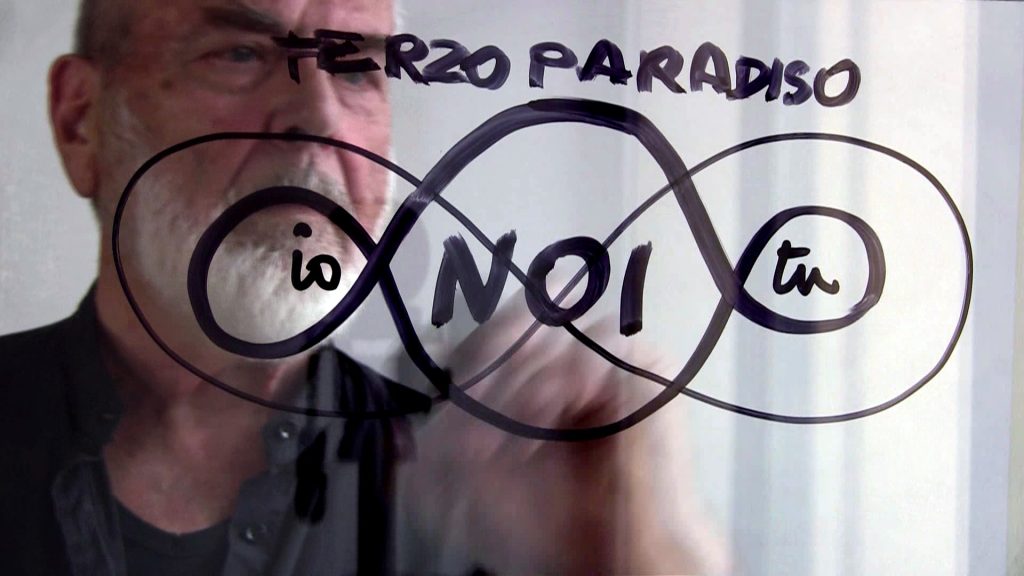
The Terzo Paradiso is one of the most emblematic works by Michelangelo Pistoletto, a leading figure in Italian and international contemporary art. It was born as an evolution of the mathematical symbol for infinity: to the traditional structure composed of two loops, the artist adds a third, central circle. The three circles represent three symbolic phases in the history of humanity: the first depicts original nature; the second represents artifice—technology, science, and the production system—while the central third circle represents a new synthesis, a future phase in which nature and artifice achieve a responsible balance. The artwork does not possess a fixed or definitive form, but is realized through ever-changing materials and adapts to the contexts in which it is activated.
The project takes on a special meaning during the fiftieth anniversary of the Biennale del Ferro Battuto di Stia, linking the productive identity of the region with a contemporary vision. Wrought iron, a material that has always characterized the Biennale, becomes the medium through which the symbol of the Terzo Paradiso takes shape, uniting artisanal knowledge with the language of contemporary art and enhancing local skills as an expression of cultural production. The creation of the artwork will involve blacksmiths, institutions, and the community in a shared journey, confirming the role of the Biennale as a place of participation and co-creation.
The artwork will be inaugurated during the special event scheduled in Stia from September 4th to 6th, 2026, and will then be donated to the Municipality to be permanently displayed in a public space within the town.
The collaboration with the Fondazione Pistoletto Cittadellarte fits into a path that, since the birth of the Biennale in 1976, has seen the event weave together the world of art with that of craftsmanship. This is also evidenced by the Biennale’s logo, the “Fabbro” (The Blacksmith), drawn in sanguine and charcoal in 1976 by Pietro Annigoni, a painter of Milanese origin deeply connected to Stia, where he owned a residence. This emblem has accompanied the event since its inception and today, fifty years after its birth, continues to represent its identity, following a dialogue between great artists and master blacksmiths that finds a new and significant chapter in the creation of the Terzo Paradiso.
Among the projects strengthening the European dimension of the Biennale is also Iron Notes, an initiative co-funded by the European Union under the Creative Europe program, created to promote the artisanal tradition of iron forging and to stimulate cultural reflection on its role in contemporary times.